
Many EU consulting firms face a dilemma: clients expect the speed and analytical leverage allowed by generative AI, yet those same clients are tightening procurement standards, updating NDAs, and scrutinising how external advisers handle their data. Meanwhile, the EU AI Act has moved into phased enforcement alongside existing GDPR obligations.
Most compliance failures in small and medium-sized consultancies do not stem from reckless behaviour, but happen when firms apply traditional IT policies to probabilistic AI tools or misread legal responsibilities. Six areas stand out where consulting firms frequently misjudge exposure.
1. Relying on acceptable use policies without technical guardrails
Many consultancies start by issuing an Acceptable Use Policy (AUP) instructing staff not to upload confidential client data or personal information into consumer-grade AI platforms. Whilst internal rules are necessary, a policy document is an administrative instruction, not a technical control.
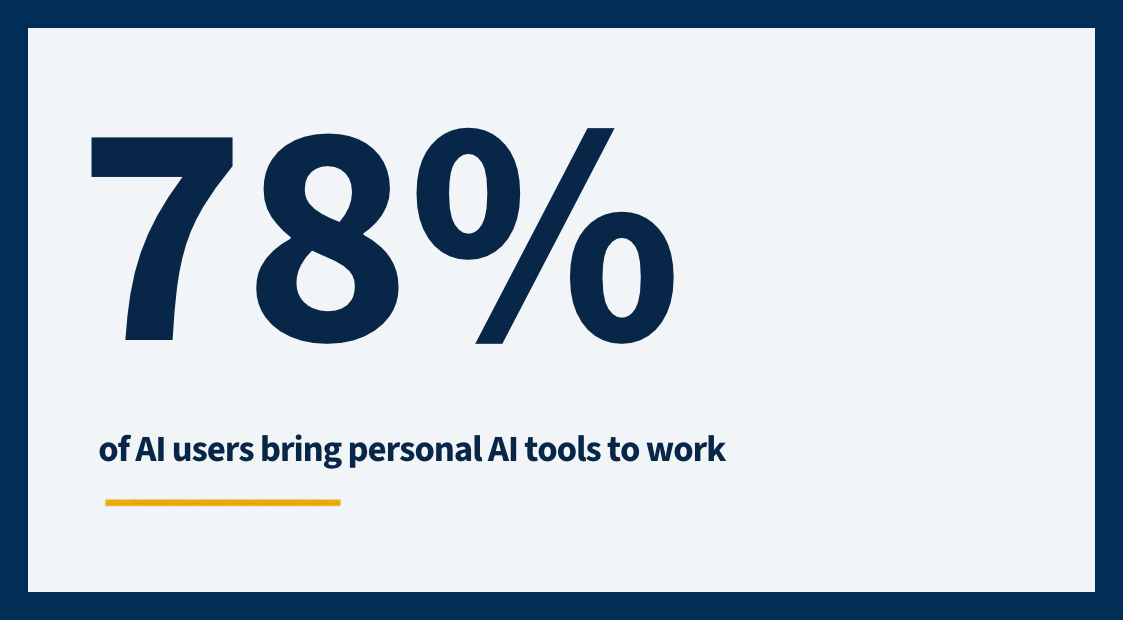
Source: Work Trend Index 2024, Microsoft/LinkedIn
When teams lack capable enterprise tools, informal adoption fills the gap: Microsoft and LinkedIn's Work Trend Index (2024) found that 78% of AI users bring personal AI tools to work. Even when diligent consultants attempt to strip identifying details before prompting, research demonstrates that manual anonymisation rarely holds up, with just 15 demographic attributes needed to re-identify 99.98% of individuals in an anonymised dataset (Rocher et al., 2019, Nature Communications).
2. Treating AI literacy as a tick-box exercise
Since February 2025, Article 4 of the EU AI Act requires organisations deploying AI to ensure staff possess sufficient AI literacy tailored to their technical knowledge, experience, and working context.
Circulating a static legal memo rarely meets this standard. In consulting, practical literacy means understanding the operational boundaries of LLMs: why they excel at qualitative synthesis and structuring arguments, yet fail at deterministic maths or factual retrieval. Empirical research from Stanford RegLab illustrates why this distinction matters, finding that general-purpose LLMs hallucinated between 58% and 82% of the time on specialised legal and regulatory queries whilst presenting fabrications with high confidence (Dahl et al., 2024, Journal of Legal Analysis). Effective governance embeds role-specific guidance directly into daily workflows rather than relying on one-off briefings.
3. Underestimating automation bias in client deliverables
Because large language models produce fluent, authoritative prose, reviewing AI-generated work requires different scrutiny than reviewing drafts from a junior analyst. Human-factors research defines automation bias as the tendency for reviewers to lower cognitive vigilance when supervising a system that appears competent, shifting from active interrogation of the logic to passive editing of surface phrasing (Parasuraman & Manzey, 2010).
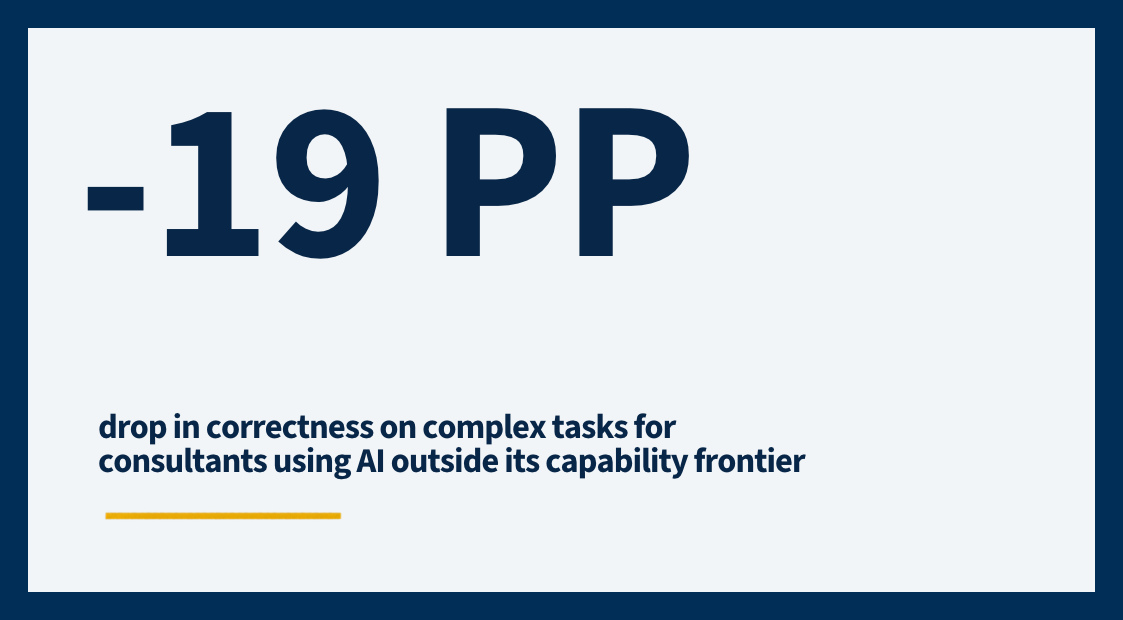
Source: Dell’Acqua et al., 2023
A field study by Harvard Business School, Wharton, and MIT Sloan with Boston Consulting Group quantified this risk across 758 consultants (Dell'Acqua et al., 2023). On tasks within the model's capabilities, productivity and quality rose significantly. However, on complex analytical tasks just outside the AI's capability frontier, consultants using AI were 19 percentage points less likely to produce correct solutions than those working without it. Skimming internal AI meeting notes carries minimal risk, but applying light-touch review to client deliverables creates severe professional liability and falls short of meaningful human oversight under the EU AI Act.
4. Misunderstanding what triggers ‘high-risk’ classification
Everyday consulting tasks like drafting reports or summarising research typically rely on general-purpose models and carry minimal regulatory burden under the EU AI Act. However, AI systems are classified as high-risk whenever they have a material, consequential impact on individuals' lives, fundamental rights or socioeconomic opportunities. This affects two sets of use cases:
- Internal workforce management: Using AI to screen CVs, filter candidates, evaluate performance, or inform promotions.
- Specific client use cases: Using AI to evaluate creditworthiness, price health or life insurance policies, or decide who gets access to essential public services.
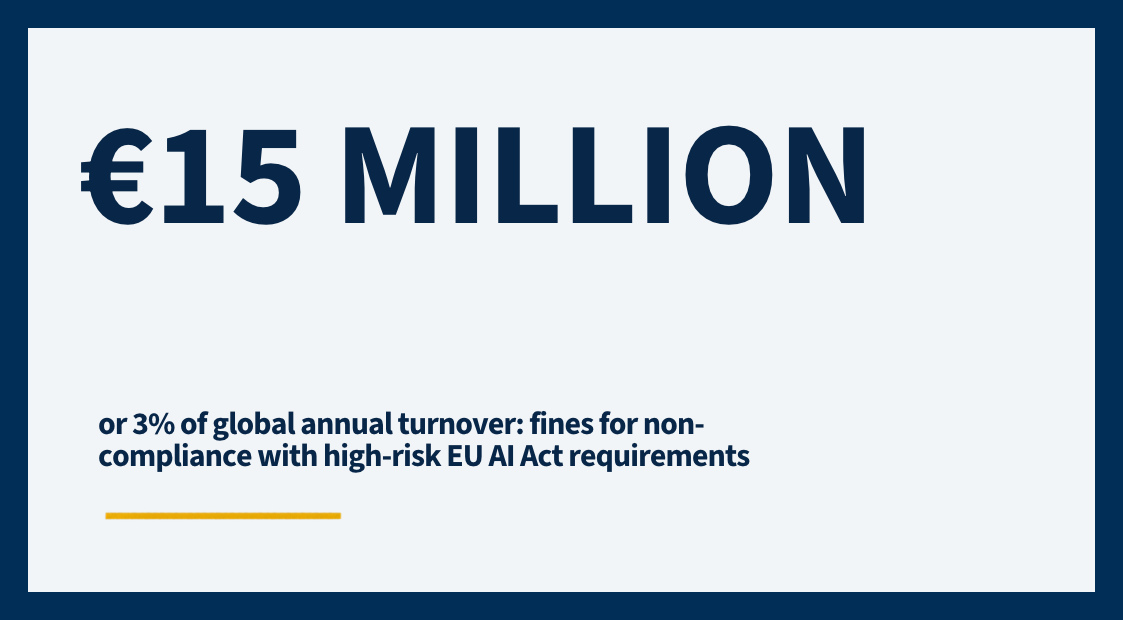
Source: EU AI Act, European Commission
Deploying a high-risk system triggers strict statutory duties, including oversight by trained personnel, six-month automated log retention, and informing affected individuals. Non-compliance carries fines of up to €15 million or 3% of global annual turnover. In addition, the reputational fallout of a compromised client engagement can be severe.
5. Inadvertently becoming an AI ‘provider’
The EU AI Act distinguishes between two main roles:
- Deployers: Organisations that use existing AI tools in their business, subject to basic oversight and AI literacy expectations.
- Providers: Organisations that build AI systems or offer them under their own name.
A consultancy may accidentally become a Provider if it significantly customises a model, wraps an API, or brands a tool created for high-risk uses, such as custom candidate screening or credit scoring. This shift triggers extensive developer obligations, including technical documentation, rigorous risk assessments, product registration, and formal safety marking.
6. Overlooking third-country data transfers under GDPR
AI governance is inseparable from international data transfer rules under GDPR. While personal data moves freely within the EEA, transferring data to (or allowing remote access from) third countries requires either a European Commission adequacy decision or safeguards such as Standard Contractual Clauses (SCCs) backed by a Transfer Impact Assessment (TIA).
Commercial AI platforms often create two compliance blind spots:
- Inference routing and remote support: Many popular AI platforms, even on their enterprise tiers, process data in third countries. Even when vendors offer EU data storage at rest, live model inference, dynamic load-balancing, and safety monitoring often route prompts through US or global infrastructure. Under GDPR, routing data through third-country servers or granting remote technical support access from outside the EEA constitutes a restricted international data transfer.
- Bilateral contractual restrictions: Separate from GDPR, client Data Processing Agreements (DPAs) and NDAs increasingly restrict sub-processor chains. European companies often prefer for data to remain within the EU - a trend supported by Accenture research indicating that 62% of European leaders seek sovereign AI solutions in light of geopolitical uncertainty. This drives stricter procurement audits on where external advisers route confidential data.
How Regulumos can help
Addressing these six pitfalls does not require slowing down delivery, giving up on AI altogether, or turning consultants into compliance officers; it requires moving governance from policy documents into technical infrastructure.
LumosGPT is a sovereign AI workspace built for European SMEs that solves these pitfalls at the architectural level:
- Sovereign EEA hosting: Your data stays in an isolated, EU-hosted environment, encrypted end-to-end. Prompts and outputs are never used to train models and never transit third-party APIs outside your governance boundary, aligning directly with GDPR Chapter V and typical client NDAs.
- Multi-model flexibility without vendor lock-in: Switch freely between leading AI model providers within a single workspace rather than being locked into one vendor's ecosystem, while running the models fully within the EU. Teams can also build custom agents, skills, prompts, and memories tailored to your firm's requirements, improving analytical quality from the first draft.
- White-label workspaces for your clients: Deploy LumosGPT under your own firm's brand, allowing you to provide clients with dedicated, compliant AI tools and custom workflows without building or maintaining the underlying infrastructure yourself.
The result: your team uses capable AI and minimises compliance risk, whilst clients see that governance is built in rather than performative.
If you would like to learn more about how LumosGPT could be implemented at your business, get in touch!